The federal government addresses university research exploitation
Due to the increasing amount of foreign government interference and exploitation of federally funded research, the U.S. government issued NSPM-33, putting the responsibility on universities to develop robust security programs.
What is NSPM-33?
The National Security Presidential Memorandum 33, or NSPM-33, is a presidential directive that aims to provide action to reinforce protections of research and development (R&D) supported by the United States Government. This memorandum strives to safeguard federally funded research from undue foreign influence. In January of 2021, the U.S. government issued the memorandum under the Trump Administration. The Biden administration endorsed NSPM-33 in August of 2022.
What are the goals of NSPM-33?
- Increase protection, clarity, and consistency of research institutes receiving federal funding
- Protect U.S. national security while maintaining open collaboration within the research community
- Set clear security expectations for research institutions
- Avoid xenophobia
What’s required of organizations?
NSPM-33 requires research organizations that are awarded more than $50 million/year of federal research funding to:
- Disclose information of the personnel working on the specific research that received the funding.
- For example, a scholar, student, or visiting scholar who is part of the research must disclose whether they are supported by an external entity
- Implement additional security measures in the following 4 areas:
- Cybersecurity: Universities should implement diverse cybersecurity procedures to strengthen their IT teams and systems, such as monitoring, controlling, and protecting organizational communications.
- Foreign travel security: Universities should carry out training and security briefings for individuals participating in foreign travel for research business, teaching, conference attendance, research purposes, or any offers of sponsored travel that would put a person at risk.
- Research security training: Universities should execute training to relevant personnel on research security threat awareness and identification, incorporate relevant elements of research security into existing training, and conduct tailored training in the event of a research security incident.
- Export control training: Universities should enforce training to relevant personnel for reviewing foreign sponsors, collaborators, and partnerships to ensure compliance with Federal export control requirements and restricted entities lists.
Repercussions of not complying with NSPM-33
- Termination or suspension of the funding that the organization received
- Mandatory return of research fund
- Suspension and debarment of individuals or research organizations
With universities at risk of financial as well as reputational damage, remaining compliant with these rules and regulations is essential for research institutes to avoid incurring disciplinary action.
Strider can help universities comply with NSPM-33
Strider sources difficult-to-access publicly available data, processes it through advanced AI and our proprietary risk methodology, and delivers unique risk signals and actionable insights via our intelligence platform. View our Research Security solution page to learn more about what critical insights our platform can reveal for your university.
In an everchanging geopolitical landscape, universities need to be equipped with the right information and context to safely navigate state-sponsored risk. Reach out to a Strider representative today and see what insights our intelligence can deliver for your organization.
Safely meet your talent needs by instantly illuminating potential connections to state-sponsored risk.
How State-Sponsored Actors Target Your Organization
One of the growing threats to government, academic, and enterprise organizations is state-sponsored risk. State-sponsored actors operate with the backing and support of a nation-state. These actors engage in malicious activities with the goal of furthering their nation’s strategic interests. They often have substantial resources, expertise, and tools at their disposal, making them capable of conducting sophisticated and targeted operations. Their motivations can range from gathering intelligence, stealing sensitive information, disrupting services, and spreading propaganda.
One of the key tactics, techniques, and procedures these actors use is recruiting individuals at targeted organizations with access to the desired IP and technology. Such recruiting is often done under the guise of official visits, collaborations, and partnerships. This leaves organizations that require such relationships vulnerable to security breaches.
Shining a Light with People Search
People Search is an effective tool to help supplement your current due diligence process in making collaboration, hiring or partnership decisions. Combining our unique data with advanced AI processing, People Search provides crucial intelligence that empowers you to meet your talent needs safely. Instantly illuminate potential connections to state-sponsored risk for talent, partners, and collaborators. Identifiable state-sponsored risk includes associations with sanctioned entities, government and military organizations, industry and education associations, and oligarchs.
With the help of our team of subject-matter experts, People Search can help shine a light on the unknown of collaboration, talent acquisition, and partnerships.
See People Search in Action
As with all of Strider’s products, our intelligence is open source, so your organization’s internal data is never required. Get impactful insights from day one and meet your talent needs safely with People Search. Request a demo today.
Putin Doubles Down on Quantum
Speaking at the Future Technologies Forum in Moscow last month, Russian President Vladimir Putin compared Russia’s race to produce an atomic bomb in the 1940s with today’s efforts to develop quantum technologies. Like the race for the atomic bomb, Russia finds itself falling behind other countries’ advancements in quantum.
His comments suggest that the Kremlin will likely double down on efforts to recruit outside experts. Putin addressed the need for “heroes”—like those who worked on the atomic project—to advance the country’s computing and engineering technologies.
Putin specifically lauded Lavrenty Beria, who led the Soviet atomic project and served as the Chief of the Soviet Union’s secret police.
A Push for More Foreign Recruitment
Putin also discussed supporting the work of “compatriots” and foreign researchers through funding programs like the Mega-Grant. “Compatriot” typically refers to individuals outside of Russia who have historical, cultural, linguistic, or ideological ties to the country. The Mega-Grant Program is likely linked to the country’s intelligence services and actively targets foreign researchers and scientists to further Moscow’s strategic economic statecraft goals.
One such “compatriot” was Klaus Fuchs, the Manhattan Project scientist convicted of passing secrets to the Soviets while working at Los Alamos between 1944 and 1949. Fuchs, a Communist Party member who believed that the Soviet Union had the right to know about the atomic bomb development, may have enabled the Soviets to construct their own bomb one to two years earlier than the US expected.
At the forum, Putin discussed his intent to expand the Mega-Grant Program to help more “compatriots” and foreign researchers come to Russia and work on a permanent basis.
Get Critical Intelligence for Your Organization
As Putin outlines these intentions, organizations and governments should be mindful in protecting quantum IP and technology. As Winston Churchill famously said, “Those who fail to learn from history are doomed to repeat it.”
Strider offers a suite of products and subject-matter expertise to help your organization stay secure from state-sponsored risk. From supply chain vulnerabilities to IP theft, our open-source intelligence provides the needed insight and context to compete today. Reach out now to book a demo.
Since its founding in 2019, Strider has taken a unique approach to managing state-sponsored risk. Traditionally, companies and governments have used a manual, case-by-case response. But as foreign governments increasingly exploit organizations’ intellectual property and talent to further their national objectives, a faster, more automated security response is needed. The first of its kind for state-sponsored risk, Strider takes a big-data approach. We leverage open-source intelligence to provide organizations with actionable data that allows them to visualize, manage, and respond to state-sponsored risk and supply chain vulnerabilities.
Industry in the Crosshairs
Foreign governments have always used tactics to obtain information that could help expand their technological and military prowess—the difference today is how they’re going about it. Historically, state-sponsored actors focused on collecting classified information at a government-to-government level. Today, we also know they focus on growing their strategic advantages through the global economy. That means collecting valuable information across a wide range of industries, like artificial intelligence, quantum computing, electric vehicles, and even agriculture equipment. As we have entered this new era of geopolitical competition, many companies are at a heightened risk of state-sponsored intellectual property theft.
Strider was founded on a clear purpose, “protecting the ideals and innovations of the free world.” We achieve that purpose by providing our clients strategic intelligence and subject-matter expertise.
Strategic intelligence at your fingertips
Now that private organizations are more in the crosshairs of foreign governments than ever before, the most effective way to combat this risk is with visibility. What technologies are foreign governments targeting? What tactics, techniques, and procedures (TTPs) are they leveraging? How do they find, contact, and recruit key employees? How does an organization know which of their suppliers have ties to government and military organizations? These questions are critical in securing your IP, talent, and supply chains.
Strider collects open-source data globally from over 31,000 primary sources in multiple languages. With over 7 billion documents in our system and 12 million more added every day, Strider delivers actionable insights without our clients providing any internal data. This dynamic data reaches across borders with source documents gathered from countries including the People’s Republic of China (PRC), Russia, and Iran. The data is then processed and merged with global patents, research publications, government websites, career profiles, and other publicly available sources.
But having all that raw data is meaningless unless you can turn it into contextualized, actionable intelligence. That’s where our proprietary methodology comes in. Strider leverages multiple different AI and machine learning (ML) technologies, including natural language processing (NLP), automated machine translation, hierarchical clustering, transformers, and other AI/ML technologies. These tools allow us to quickly organize, analyze, and pull the most relevant insights for our clients in the timeliest manner possible.
Our intelligence is currently channeled into three products:
- Identify and respond to state-sponsored risk in your organization at industry and individual levels. See which of your talent and technology is at the highest risk of being targeted, so you can get a more proactive view of where to focus your time, attention, and resources.
- Defend against state-sponsored communication attempts directed at your organization. Shield can be integrated directly into your existing security capabilities and flag any risky emails or other communication attempts.
- Organizations Search is third-party due diligence tool that provides visibility into state-sponsored security, compliance, and reputational risk. Strider’s automated screening process provides actionable and contextualized data that allows clients to adapt more quickly to changing business and compliance needs.
Subject-matter experts at the ready
State-sponsored risk is complex, continually developing, and can feel overwhelming at times. Even with heightened visibility, you might be left wondering about the best course of action. For that reason, we also make available a team of leading experts on protection, big data, tradecraft, finance, and analytics. The Strider Global Intelligence Team comes from top government agencies and companies from around the world.
Our team answers questions, provides insight, conducts Requests for Information (RFIs), and offers additional context when needed. This deeper, supplemental intelligence has proven invaluable for our clients time and time again.
See our offerings in action
Our unique data combined with our subject-matter experts offer an unparalleled level of intelligence on state-sponsored risk and supply chain vulnerabilities. Experience it in action with a live demo. Because we only use open-source intelligence, our demos aren’t hypothetical. We’ll show you real data and real insights in real time. Reach out today to get connected to a Strider representative to strategize how our intelligence and products can best serve your organization.
Open-source intelligence is the backbone of Strider Technologies, and a growing critical asset in today’s global economy for economic development and strengthening national security. Greg Levesque, Strider’s CEO and co-founder, talked on the subject in a recent SCSP NatSecTech podcast hosted by Jean Meserve, which you can listen to here. Greg was joined by Varun Vira, COO of C4ADS, a nonprofit utilizing open-source data to target transnational illicit networks. Below we’ll highlight five key takeaways from their conversation.
We’re in a golden age of open-source data
Data made publicly available on the internet has been expanding rapidly over the past decade. The Covid-19 pandemic only accelerated the push of data and information online. Nefarious governments are increasingly using this publicly available information to target private industry and academia. Companies are on the frontlines of this new geopolitical battle.
Open-source data reliability is found in its scale
Some have wondered if open-source data is reliable, particularly when it comes to incorporating it into security and critical business processes. But when large amounts of data are integrated, they can reinforce each other boosting confidence in its veracity. This reinforcement of disparate data points validating the same story offers a high degree of confidence in the accuracy of the information. But it’s important to validate the data and be careful not to jump to conclusions before investigating biases and data gaps that may be present.
Governments aren’t efficiently leveraging open-source data—except one
The U.S. government—and most other governments—is behind the curve in leveraging open-source data. There are efforts to ramp up the use of open-source data and begin to look at it as a key ingredient in various U.S. government mission sets.
On the other hand, the People’s Republic of China (PRC) is doing an exceptional job of utilizing open-source data, particularly when it comes to mapping scientific talent around the world. They create scores for experts in technologies they’re interested in, and in some cases, even include an estimated cost to recruit that person. This type of data collection is not limited to academia but looks at talent in companies as well. This data is then used to fill domestic gaps within their own industries or technology fields. “The shocking thing for me,” Greg notes, “is the scope and scale of the activity. It’s happening in companies. It’s happening in universities. It’s not just a government-to-government issue.”
The government’s adoption bottlenecks: processing and leveraging data
The challenge for companies and governments alike is not acquiring data, it’s processing it in a way to derive value. A faster approach is required to increase efficiency, and governments must leverage private sector innovations to rapidly scale their capabilities. And while establishing a dedicated open-source agency is an option for the U.S. government, a cultural shift is also needed to accelerate the adoption and application of open-source data.
Government and industry should collaborate
To advance national interests and security, it’s critical for governments and industry to collaborate to maximize the value derived from utilizing open-source data. By joining forces, we can develop new capabilities that enhance government’s ability to advance its mission—whether that’s grant making, ensuring compliance with export controls, or supply chain resiliency. There’s a strategic opportunity for government to reposition and synchronize its efforts with the private sector.
At Strider, we transform open-source data to provide meaningful insights for companies and governments alike to secure their technology and find new ways to compete. Learn more about our products and solutions or book a demo to see our intelligence in action.
How Strider Technologies used open-source intelligence (OSINT) to uncover the PRC’s use of state-sponsored actors to leapfrog competitors in quantum technologies, and how that same data can help protect your IP
State-sponsored intellectual property theft is on the rise
As countries around the world enter a new era of global strategic competition, state-sponsored threats are becoming more prevalent and sophisticated. The U.S. government estimates that intellectual property (IP) theft by the People’s Republic of China (PRC) costs the U.S. economy up to $600 billion annually.
Strider Technologies utilizes trillions of open-source data points that enable organizations to proactively identify, manage, and respond to state-sponsored risk and supply chain vulnerabilities.
Case in point: China’s exploitation of Western resources to advance their quantum technologies
Take for example Strider’s report titled Quantum Dragon. Leveraging open-source data, Strider delivers new insights and findings into how the PRC exploited Western resources to leapfrog competitors in its military quantum applications.
The PRC’s strategy includes sending Chinese scientists to top quantum research labs around the world for training, then recruiting those scientists back to China through government talent programs to support the development of their quantum research programs. This strategy is publicly done in the name of “international scientific cooperation,” but these Chinese scientists simultaneously collaborate with Chinese state-owned defense companies to develop military applications for quantum technologies.
You can read the full report of our findings here.
Spotting IP theft before it happens
The same technology that uncovered China’s attempt to exploit quantum technologies can also protect your organization from similar theft. Strider combines open-source data, proprietary risk methodology, and subject-matter expertise to provide organizations direct visibility into the tactics, techniques, and procedures (TTP) that lead to state-sponsored IP theft.
This proactive approach better enables security teams to safeguard their people, protect their IP, and secure their bottom line.
Products that offer never-before-seen visibility
Strider’s products provide innovative tools to help you protect your organization with confidence. Our current offerings include:
- Insights
- Identify and respond to state-sponsored risk in your organization at industry and individual levels. Using actionable intelligence, you can take a proactive defense posture on your core technologies and talent that are most targeted by foreign state-sponsored actors. Learn more about Insights here.
- Shield
- Enhance your current security measures with risk terms directly connected to foreign state-sponsored actors. Shield can be integrated directly into your current data loss prevention (DLP) system and flag any risky emails or other communication attempts directed at your talent. Shield is constantly updated with new and additional data every month. Learn more about Shield here.
- Organizations Search
- Screen suppliers at scale for geopolitical and compliance risk. Strider’s automated screening process provides actionable and contextualized data that allows clients to adapt more quickly to changing business and compliance needs. Learn more about Organizations Search here.
Identifying risk in your organization
State-sponsored risk continues to pose critical threats for the world’s biggest organizations. See why Fortune 100 companies are deploying Strider’s services. Request a demo to experience our proprietary data in action—visualized in a way that will deliver immediate insights.
You may also be interested in:
Deadly Effects of Stolen Technologies and How to Secure Your Organization
Lost in Translation: Core Technology Can’t Be Bought
One of the most difficult aspects of managing state-sponsored risk is knowing what to look for. Seemingly innocuous communications and actions can fly under the radar until it’s too late. Strider Technologies changes that with Shield.
Shield is risk visualized. Properly implemented, it allows you to identify and resolve risks before they become serious problems. Here’s how Shield can support your insider threat and cybersecurity teams.
What is Shield?
Shield is a dynamic collection of data, including contact information and key words, that are directly connected to individuals, entities, and programs associated with foreign state-sponsored actors that are targeting commercial and other private organizations’ intellectual property.
Shield can be integrated directly into your current data loss prevention (DLP) system and flag any risky emails or other communication attempts. Shield is constantly updated with new and additional data every month.
What makes Shield different from other cybersecurity tools?
Shield is unique for several reasons.
- We do not require any client information. We only use open-source data to bring to light potential risk indicators.
- Because these state-sponsored actors use sophisticated and blended approaches, identifying their approach without contextual information can be extremely difficult. Shield delivers that context by offering insights from subject-matter experts on the tactics, techniques, and procedures (TTPs) of state-sponsored actors. Our subject-matter experts will help guide confident decision-making in your organization.
- Shield has extremely robust coverage, and it’s only expanding. Currently, we have over 12,000 selectors and terms that are used by state-sponsored actors.
How can you use the data from Shield?
Companies utilize the data from Shield in different ways.
- You can block all emails from individuals and entities listed in Shield.
- You can be notified when emails come from these individuals or entities. Once notified, you can investigate further on your own terms.
- You can also provide training to employees based on the domain names and terms that come through your system.
What does Shield look like in action?
Here are some quick examples of how Shield has helped our clients.
- Shield alerted Client A that an employee received an email from a restricted entity from the People’s Republic of China (PRC). Although this employee and team had been approved to work with this entity previously, the company reversed their decision after Shield notified them that the entity was on the sanctioned list.
- Client B’s Shield flagged numerous emails that were coming from individuals with ties to the Chinese Academy of Sciences. Shield revealed that these individuals belonged to a department that worked on the same technology as the client. The client deemed it too risky to continue receiving emails from these individuals, blocked further communication attempts, and provided extra training to the engineers. Without Shield, the client would not have known that the Academy was approaching their engineers in a targeted manner.
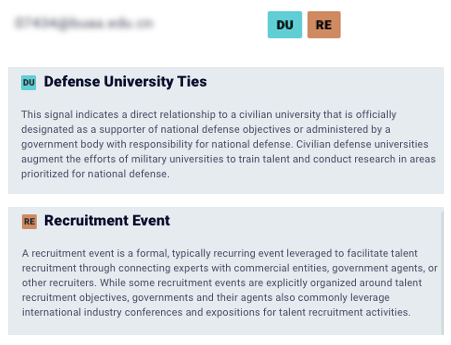
Shield’s database continues to grow
State-sponsored actors continue to evolve, and Shield evolves with them. Data gets refreshed and coverage gets expanded monthly. We regularly monitor the latest developments to ensure we provide the most current and accurate data points.
When you know where to look, risk is easier to identify. Shine a light on potential threats with Shield. Explore our product page to learn more.
At Strider we believe in open scientific collaboration. Throughout history some of the greatest scientific advancements have been the result of close-knit international partnerships. As geopolitics shift, it’s critical to ensure these collaborations don’t advance adversary military programs or create reputational or national security risks to institutes of higher learning.
The Canadian Government’s Innovation, Science and Economic Development Program recently released a guidebook titled Conducting Open-Source Due Diligence for Safeguarding Research Partnerships.
The focus of this guidebook is to provide open-source due diligence methods – specifically a guide for identifying risks within research partnerships. The goal is to help researchers and institutions safeguard against national security risks when partnering with foreign governments on research initiatives.
The first part of this guide provides an introduction and background. It notes that, “not all partnerships are risky,” but also expounds on how some activities by foreign governments pose an acute risk to Canadian national security interests, the Canadian research ecosystem, and the underlying research itself. Some of the more significant risks identified include:
- Research being transferred to a foreign government without consent.
- Tampering with research findings to devalue the findings, damage a researcher’s reputation or undermine the benefit the research can provide.
Due to these risks, the Canadian Government wants researchers and institutions to better equip themselves when engaging in foreign partnerships.
Leveraging open-source due diligence methods can be a force multiplier to verify identities, understand relationships and motives, and mitigate conflicts of interest. The guide also expounds on the ways to ethically conduct open-source due diligence, how to create a plan, how to execute that plan, and communicate your findings.
The guide provides additional resources and best practices on how to leverage open-source data. One additional inclusion is a list of commercial tools that can be used to help safeguard research. Strider was proud to have our product, Shield, listed as a resource for Canadian research institutions to identify and mitigate potential risk emanating from foreign partnerships.
We applaud the Canadian government’s proactive steps to educate researchers, universities, and the public of these risks. It takes a collective effort to safeguard our innovations and maintain the values that underpin open scientific collaboration.
Conducting Open Source Due Diligence for Safeguarding Research Partnerships Guidebook
https://publications.gc.ca/collections/collection_2022/isde-ised/Iu37-34-2022-eng.pdf
According to Crunchbase, more than 90,000 workers were laid off in 2022 in the US tech sector alone.[1] With continued economic uncertainty in 2023, many organizations are continuing to consider the potential need to lay off employees and downsize their operations. This is causing employees to have anxiety concerning their employment status.
Such anxiety will inevitably lead those with access to the organization’s valued intellectual property (IP) to consider exfiltrating it from the organization’s network to somewhere they can maintain access, if and when their employment status changes. Most of these incidents will not be made with the intent to steal the IP, or damage the organization, but to preserve their access to the material for later referral.
However, there will be other employees who recognize the value of the IP and will feel they are justified in maintaining access because they participated in the creation and therefore feel they deserve to reap the associated perpetual rewards. These same individuals may offer their related IP expertise to competitors during their efforts to find their next employment and want to be able to have an example of their work to share. All of these cases represent a challenge to any organization’s Insider Team and their ability to respond to the changing conditions.
Following are the four measures that insider threat teams can proactively take to secure the organization’s IP in these challenging times.
#1 As soon as identified, conduct enhanced monitoring of the employees who are mostly likely to be affected by layoffs.
Studies show that half of departing employees leave with confidential company information — either deliberately or unintentionally. By determining the work units who will be laid off in advance of their notice, the insider threat teams can set up a monitoring system that will capture the affected employee’s efforts to exfiltrate data as a response to the notice.
For this monitoring to be effective, however, the insider threat teams need to know what information is most critical to the organization, and they need to have the capacity to respond quickly to recover this material when exfiltration is detected.
Additionally, insider threat teams need the ability to prioritize their investigative response so that they are focused on the greatest long-term risks to the organization. While conducting enhanced monitoring of every employee exiting the organization may be possible, responding to every incident in which a departing employee has exfiltrated data will be a challenge.
Prioritizing the response, so the insider threat teams are focused on the greatest risk, is essential to mitigating damage.
#2 Offer departing employees the opportunity to submit materials they want to take with them for a review.
This opportunity allows the employee to consciously think of the material they want to remove from their computer hard drives, recognize that they are not allowed to make this decision independently, and give them the opportunity to obtain approval to remove non-sensitive material.
The vast majority of departing employees will have personal items, such as family photos, tax returns, and personal correspondence that they would like to keep access to – even if the organization had prohibited the storing of personal material on their equipment all along. And while employees conduct large volume data transfers from their work computers to their home computers, it is highly likely that the organization’s valued IP will be mixed in with those personal material. By having the review process, such mix-up can be prevented.
It is also critical when reviewing the items to determine the intent and the damage of the exfiltration, the insider threat teams look for materials that contain the organization’s Crown Jewels and for materials which are desired by competitors, including nation-state actors, as they represent the greatest potential to harm the organization.
#3 Raise employee awareness about the organization’s governance regarding the exfiltration of data prior to announcing layoffs.
This applies to both the employees who are about to be terminated and those employees with long-term future with the organization. The most common answer provided when an employee is questioned about unauthorized exfiltration is, “I did not know I was violating an organization policy.” Raising the awareness for supervisors and employees is a proactive step to prevent the loss of IP and reduce the amount of unauthorized IP exfiltration. It can also be a positive message shared with employees to collectively work together to protect the organization’s future. If this training is shared after announcing layoffs, it will be interpreted as a threat and could lead to unintended consequence of further damaging company morale and culture.
#4. Maintain awareness of which external entities could benefit from the organization’s layoffs.
Organizations can’t dictate where their laid-off employees find their next employment. However, maintaining an awareness of which entities could benefit from the organization’s former employees is extremely valuable.
After layoff announcements are made, the departing talent is likely to draw the attention of nation-state actors, competitors, or startup companies, looking to reap the benefits. Limiting the ability of these actors to contact and communicate with the departing employee could reduce their success. Nation-state actors are known to guess the employee’s email addresses by utilizing a person’s name and their company’s email domain in order to establish a channel to communicate. If successful, nation-state actors will use this method to determine the employee’s interest in future employment with one of their favored enterprises.
Conclusion
Company layoffs, real or perceived, represent a real threat to organizations’ ability to safeguard their most valued IP. Insider threat teams must implement proactive measures and processes to effectively minimize such threat.
[1] Vedantam, K. (2022, December 16). Tech Layoffs In 2022: The U.S. Companies That Have Cut Jobs. Crunchbase News. https://news.crunchbase.com/startups/tech-layoffs-2022/
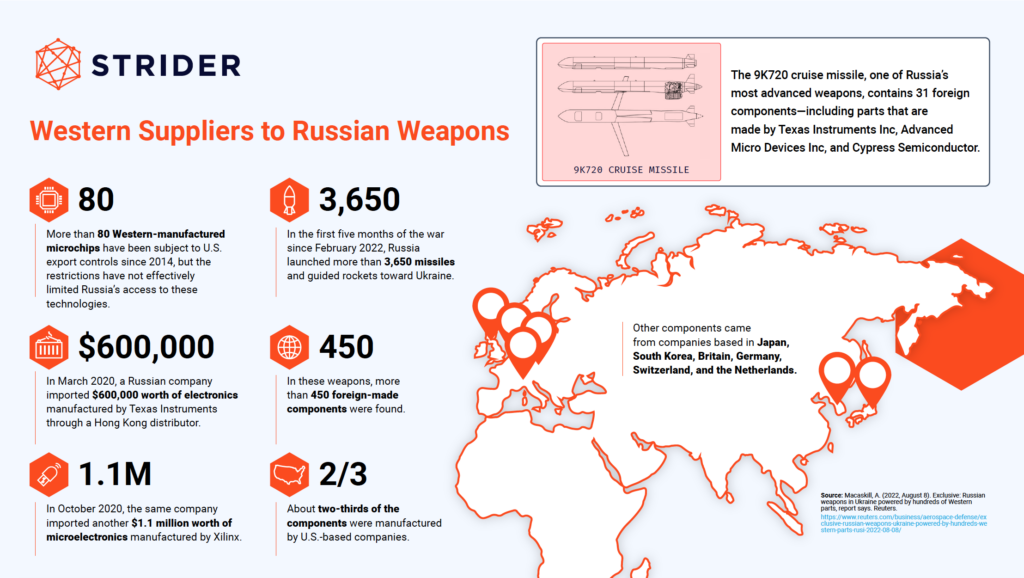
In August, Reuters published an article “Exclusive: Russian weapons in Ukraine powered by hundreds of Western parts,” which highlights the prominence of Western-developed parts in Russian weapons. This article focuses on the critical need for every organization to be more proactive in securing technology from unwanted players. To make this a reality, a more holistic and proactive defense is required.
Government sanctions are not enough
The United States introduced wide-ranging sanctions against Russia in the wake of Russia’s annexation of Crimea. However, investigations have shown that “Russia’s military [still] remains reliant on foreign microchips… and that Western governments were slow to limit Russia’s access to these technologies particularly after President Vladimir Putin’s invasion of Crimea in 2014.”[i]
To truly empower sanctions and make them effective, technology developers – as well as their partners – must have a more holistic and preventive defense posture. Creating this defense mechanism involves:
- Knowing what and who to protect
- Ensuring that all touchpoints are secure
- Invest in long-term, evolving solutions
Knowing what and who to protect
Organizations must identify and prioritize their key assets and technologies that are being pursued by adversarial entities, including nation-state actors, and allocate resources accordingly. Organizations must be strategic in identifying and deploying protection to what is most vulnerable.
The same process must then expand for the protection of talent. Organizations must be aware of key personnel that have access to these technologies and protect them proactively. It is common for nation-state actors to do thorough research on an organization’s personnel to know who to approach. To defend against this systemic attack from nation-state actors, organizations need to find innovative solutions to protect their most important people.
Ensure that all touchpoints – including procurement partners as well as distributors – are secure
The U.S. government announced in March that Russian firms used front companies to purchase electronics for Russia’s military. In fact, the Russian customs records show that in March 2021, a Russian company imported $600,000 worth of electronics manufactured by Texas Instruments through a Hong Kong distributor. Seven months later, in October 2021, the same company imported another $1.1 million worth of microelectronics made by Xilinx.
This portrays the desperate need for the comprehensive visibility into the supply chain risk landscape. To protect your technology from beginning to end, every touchpoint needs to be secure and that requires comprehensive visibility into partners’ relationships with other entities. By identifying existing and past relationships that partners had with other entities, organizations can mitigate risks and pursue safer and more compliant partnerships.
Invest in long-term, evolving solutions
A holistic and proactive defense cannot be achieved overnight. It is an evolving and expanding process with long-term goals in mind. After all, this is the way that many nation-state actors function. They are evolving and expanding their strategies and tactics.
For example, while Russia’s invasion of Ukraine took place in 2022, evidence shows that “Moscow acquired critical technology from companies in the United States, Europe and Asia in the years before the invasion.”[i] [emphasis added] Countries like China also routinely produce their evolving vision and objectives through documents like Made in China 2025 or series of Five-Year Plans.
As nation-state actors and other adversarial entities evolve, so should organizations and their strategies and tactics for defense. Devastating effects of Russian weapons that are powered by over 450 foreign components are a call for every industry and every organization to be mindful of protecting their technology and innovations.
The Reuters article concludes that “Russia’s military could be permanently weakened if Western governments strengthen export controls, manage to shut down the country’s clandestine procurement networks and prevent sensitive components being manufactured in states that support Russia.” It causes all technology developers in the West to ask what to be done now. We are at the crossroads. Creating more proactive and holistic defense postures is the only way to secure your valuable technology now and in the future.
[i] Macaskill, A. (2022, August 8). Exclusive: Russian weapons in Ukraine powered by hundreds of Western parts, report says. Reuters. https://www.reuters.com/business/aerospace-defense/exclusive-russian-weapons-ukraine-powered-by-hundreds-western-parts-rusi-2022-08-08/